
c/o Park Associati, Via Garofalo 31
20133 Milan
MON–SUN 11:00 AM–7:00 PM
ARTISTS:
Mattia Barbieri
Mario Schifano (Collezione Ramo)

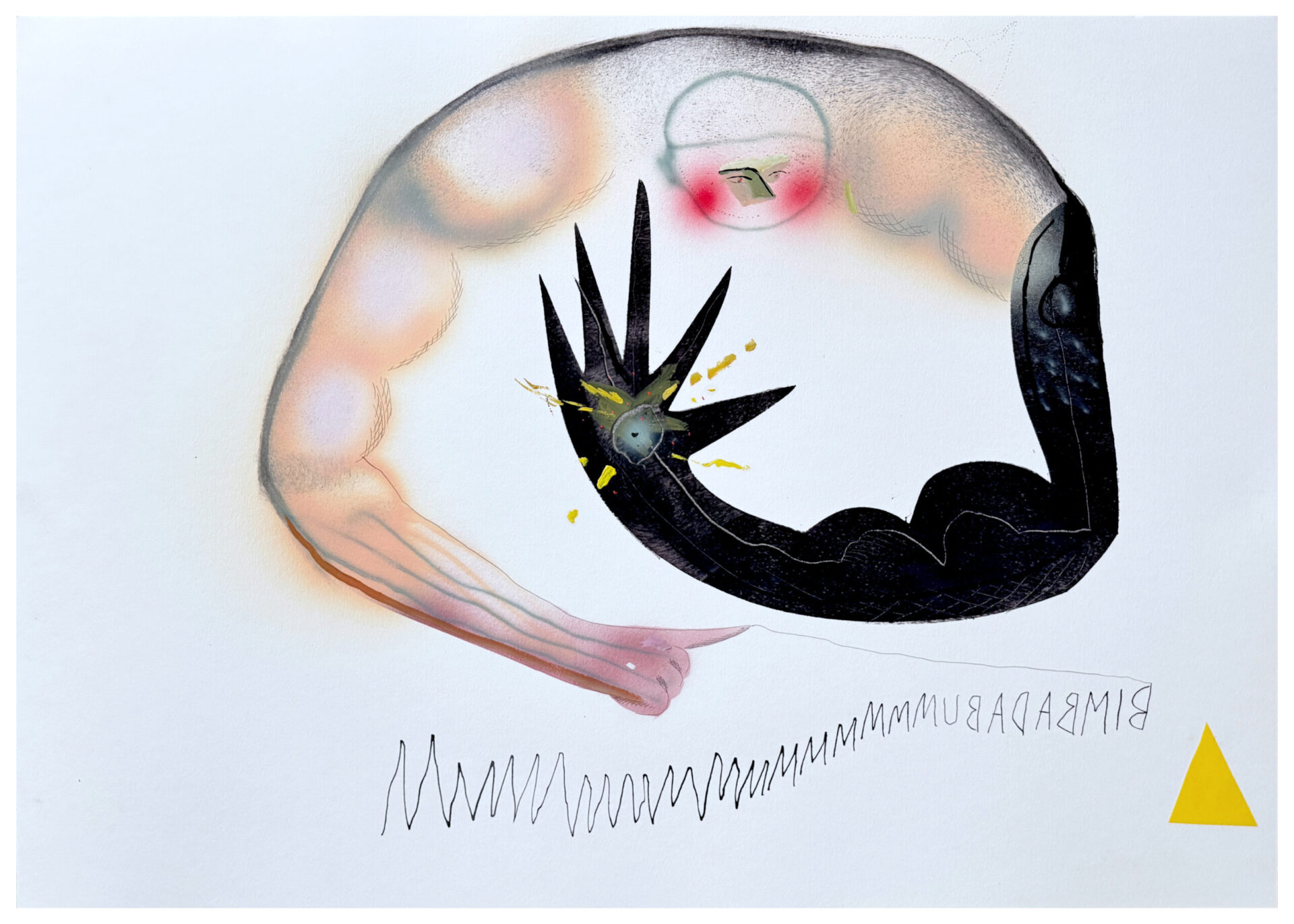
Barbieri, BIMBADABUMMM, 2026, china, olio, tempera e pellicola adesiva su carta, 42×59,4 cm
Schifano
Mattia Barbieri answers the questions of
Irina Zucca Alessandrelli, curator of the Collezione Ramo
What does drawing mean to you?
Drawing is ritual and everyday life: it opens my day with the good-morning post-it note left on the breakfast table for my little girls to find when they wake up, and it slips into every good opportunity to illustrate the menu that accompanies holiday meals. Drawing is the hand that keeps travelling without contemplating error, because each mark that follows the previous one directly conveys a sense of balance where impulse had taken over. Drawing is origin, because, if you want, you can make it with nothing at all, such as a branch dragged across the sand by the sea; and yet it can become extremely sophisticated when you open yourself up to the use of multiple tools. Drawing is a practice deeply inherent to the structure of my work: drawing, painting and sculpture have a relationship of complementarity and equivalence, a triad rooted in common ground, while branching out individually. I never draw in order to plan. Never. I draw to draw. It is probably the most intimate practice, the one that gives you everything without asking for anything in return. Perhaps it is like having a dog, even though I don’t have one.
What materials, techniques and creative processes do you use when working on paper?
If it writes, if the tool leaves a mark, then it can be used to make a drawing. India ink and nib, airbrush, oil, collage — every means is good for weaving together the kinds of marks I love: soft and then cutting, sharp, fine, meticulous and then ungainly, awkward; in other words, when the structure is broken. It is somewhat like the linguistic short circuit of a witty remark or a pun, which generates a reaction or laughter because it breaks the rule, calling the very meaning of language into question. No mark is ever useless, because, as they say in Brescia, “Fès is more.” I like to use up entire reams of paper, making hundreds of drawings, perhaps because I favour the process over the final result in itself. Drawing is a challenge to form that necessarily requires quick reflexes in order to surrender to becoming. Like in a car race, I try to mediate between the recklessness of a fast pedal and the concentration of a steady steering wheel. I begin a good number of sheets simultaneously, in a frenzy, and then welcome each one with the care reserved for someone who is unique.
Why did you choose this work from the Ramo Collection?
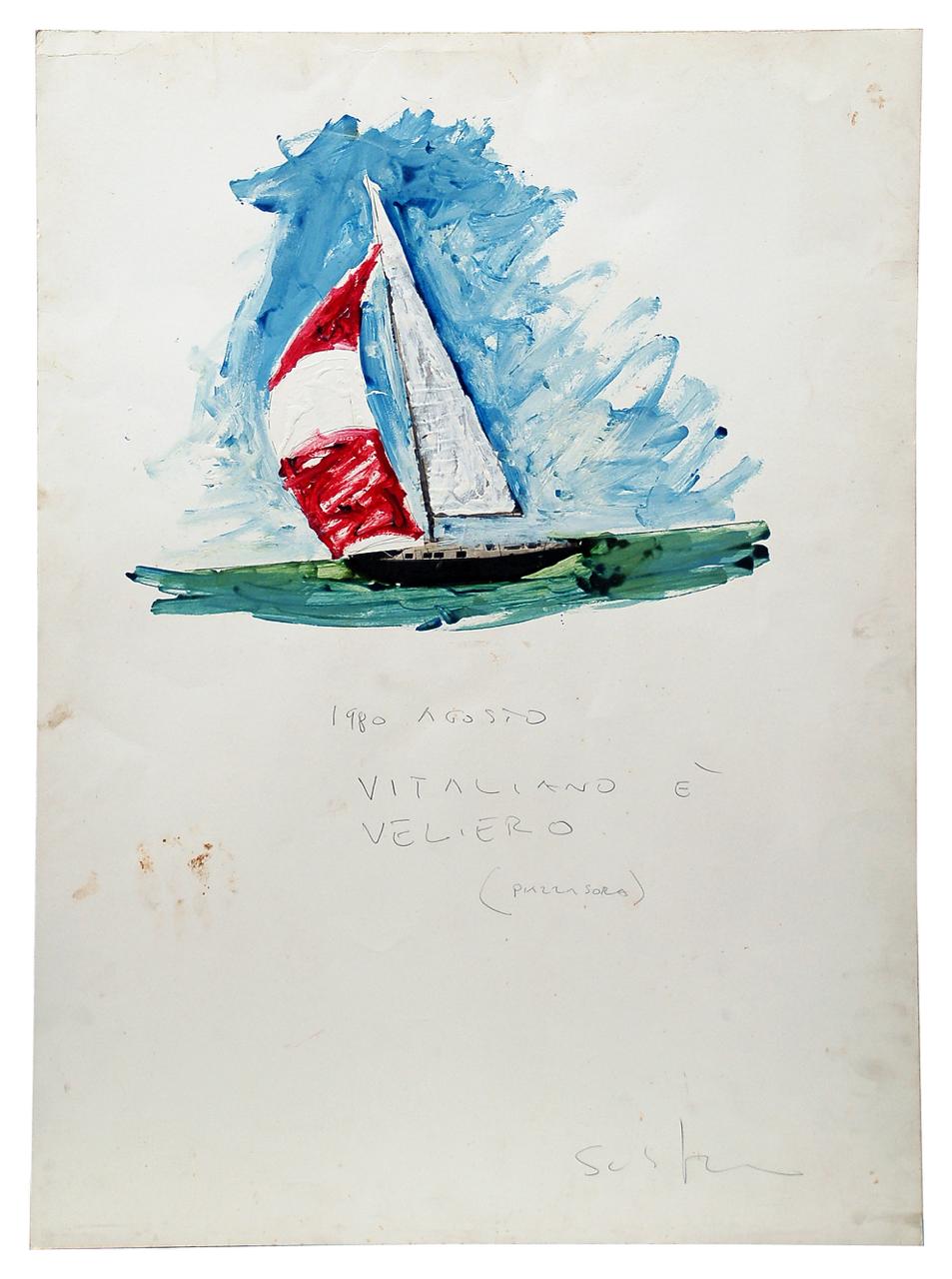
I chose Vitaliano è veliero by Mario Schifano, an artist I have always loved for the “punctual frenzy” of his work, an aspect in which, through my own practice, I recognise myself. Perhaps partly because it is how I feel when I draw. Reckless, in a GRANTURISMO. That is also why I chose it: because, in addition to the fact that he used collage, painting and pencil to make it, it is a mixed technique that I also employ in my drawings. Everything, then, as long as it writes… everything, as long as the drawing sails full steam ahead!
What value does your dialogue with the Masters of the 20th century have for you?
I was born in the 20th century. Their presence is as precious as it is indispensable. In art, the passing of the baton also takes place within the ranks of the most radical revolutions. Sometimes the dialogue is conscious; at other times, the genius loci transmitted by our Italian tradition imposes itself, bittersweet and sugary-sweet. Nothing comes from nothing, and the authorship of a gesture, a subject or an aesthetic constitutes an order of things that must be absorbed, processed and translated anew. Perhaps we, too…
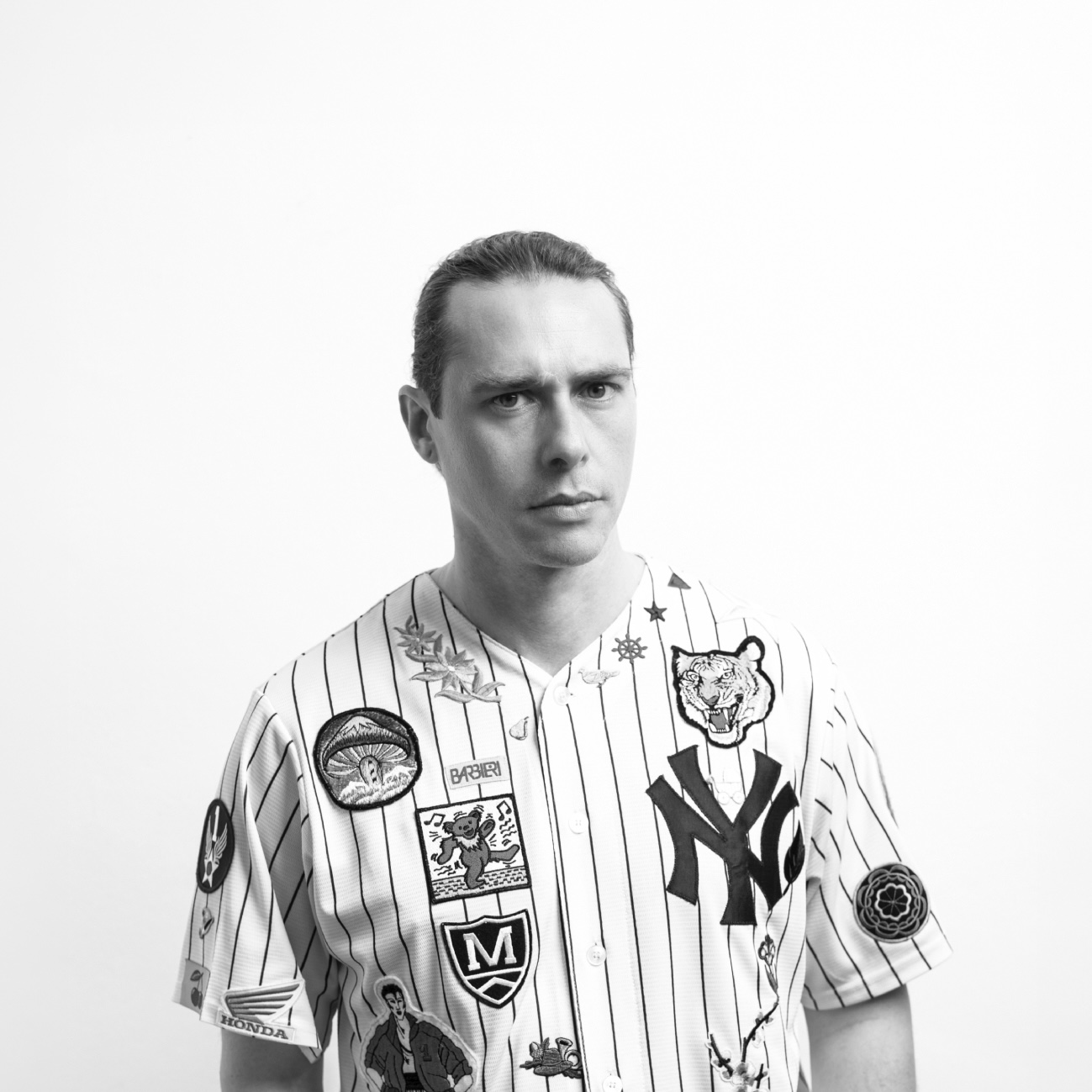
MATTIA BARBIERI (Brescia, 1985) graduated in Visual Arts from the Brera Academy of Fine Arts. He lives and works in Milan. His work unfolds through drawing, painting and sculpture, disciplines united by a constant and ever-changing process. For Mattia Barbieri, artistic practice is like a dialect, a language unto itself with its own grammar that answers only to itself, the reservoir into which everything flows: knowledge and interests, jokes and prayer, struggle and reconciliation, introspection and exploration of the outside world.